
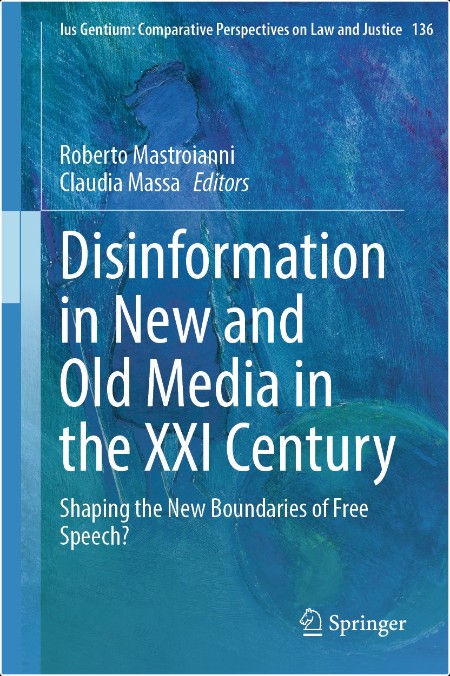
Disinformation in New and Old Media in the XXI Century | 13.99 MB
Title: Disinformation in New and Old Media in the XXI Century
Author: Roberto Mastroianni, Claudia Massa
Category: Nonfiction, Reference & Language, Law, Comparative, International
Language: English | 250 Pages | ISBN: 9783032188304
Description:
The volume examines, from a legal point of view, various regulatory, political, technological and democratic issues related to the disinformation phenomenon in both "old media" (newspapers and broadcasting) and "new media" (digital platforms, social media and artificial intelligence) in two different scenarios: elections and war.
Disinformation is in fact relevant, inter alia, in light of two very significant events of recent years. First, 2024 marks a year of general elections in numerous regions globally, involving 76 countries (including, within our continent, the elections for the European Parliament as well as parliamentary and presidential elections in several EU Member States such as Portugal, Belgium, Austria, and, on the other side of the Atlantic, the Presidential elections in the United States). Second, 2025 is the fourth year of the Russia/Ukraine military conflict. The common thread that binds these two situations is clear: disinformation may significantly impact the formation of public opinion, thereby prompting public decisions that risk being based on false or seriously distorted news. Starting from the two-abovementioned scenarios, the chapters of the volume concern the current "state of health" of freedom of expression in both "old media" and "new media", and they contribute to answer three main questions. First, are governmental repressive, corrective or even preventive actions against "false" information in the two scenarios discussed here the right solution? Could any prohibition of disinformation rather lead, paradoxically, to the opposing result of producing a "chilling effect", in itself harmful to the free circulation of ideas, including those who "shock or disturb"? Second, is it still valid that the best antidote to disinformation and hate speech is more speech? Is this conclusion still correct in case of absence of pluralism in the media, when the main sources of information are controlled by one or few media companies? Third, is propaganda of war a specific situation that merits being distinguished from any other form of disinformation?
Download From Below Rapidgator & Nitroflare Links
Please Login or Register to see this code Please Login or Register to see this code